
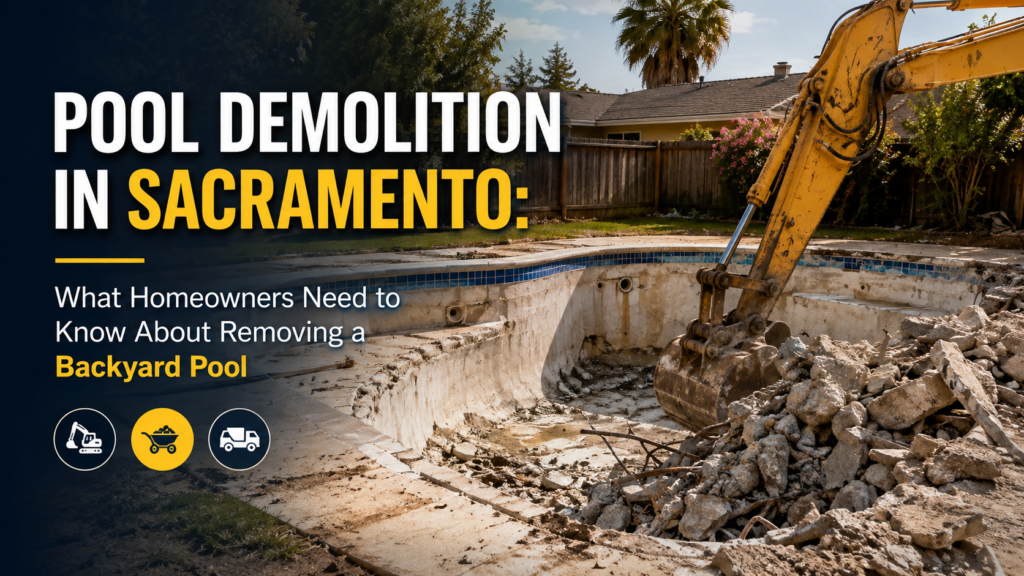
Sacramento’s hot summers have historically made residential swimming pools a popular backyard feature. But pools require consistent maintenance, consume significant water (a meaningful consideration in California’s drought-conscious environment), and occupy substantial lot space that could serve other purposes. As Sacramento homeowners weigh the ongoing costs of pool ownership against the potential to reclaim that space for an ADU, expanded landscaping, a sports court, or simply a low-maintenance yard, Pool Demolition Sacramento has become one of the most frequently requested residential site services in the region. This guide explains the pool demolition process in Sacramento, the two primary approaches available, and what homeowners should know before proceeding.
Why Sacramento Homeowners Remove Pools
The ADU (accessory dwelling unit) trend is currently the most significant driver of pool demolition in Sacramento and the broader California market. Sacramento City alone issued over 1,100 ADU permits between 2020 and 2024, and a substantial proportion of ADU projects involve backyard pool spaces. California’s strong ADU policies, combined with Sacramento’s housing shortage and the income potential of a rental ADU, have motivated many homeowners to view their backyard pool as a better source of housing revenue than recreational space. Critically, Sacramento County will not permit a habitable structure including an ADU over a pool shell that remains in the ground. Full pool removal and engineered backfill are required for any development over a former pool footprint.
Maintenance costs and water consumption are independent motivators. A Sacramento gunite or concrete pool requires consistent chemical management, pump and filter maintenance, and periodic resurfacing. Sacramento’s periodic drought restrictions and mandatory water conservation programs have made high-water-use features like swimming pools increasingly scrutinized. Homeowners who are no longer using their pool actively often find that removal eliminates a recurring cost and compliance concern.
Insurance considerations also play a role. Homeowner insurance policies in California typically require higher liability coverage for properties with pools. An unused or deteriorating pool represents a liability risk with no recreational benefit, making removal the more practical choice.
Partial Pool Removal vs. Full Pool Removal in Sacramento
Sacramento demolition contractors offer two primary pool removal approaches: partial removal (also called partial fill or abandon-in-place) and full removal. The distinction between them is significant and has lasting implications for what can be done with the site afterward.
Partial pool removal involves breaking down the top portions of the pool walls typically to 18 to 30 inches below grade drilling drainage holes in the pool floor to prevent water collection beneath the fill, and then backfilling the pool cavity with soil, gravel, or a combination of materials, compacted in layers. The gunite or concrete shell of the pool remains partially in the ground. Partial removal is faster and less expensive than full removal and is appropriate when the goal is simply to convert the space to general landscaping, a patio, or non-habitable use.
However, partial removal has significant limitations in Sacramento. Sacramento County and the City of Sacramento will not permit habitable structures including ADUs, room additions, or any occupied structure over a partially removed pool shell. If the homeowner sells the property in the future, California law requires disclosure of a partial pool removal to potential buyers, which can affect property value and buyer perception. Improperly compacted partial fill can cause uneven settling over time, creating surface depressions that require correction.
Full pool removal is the complete excavation and removal of the entire pool structure shell, walls, floor, plumbing, and all associated concrete. The cavity is backfilled with engineered fill material compacted to at least 90% of maximum density per ASTM D1557. For projects where an ADU or other habitable structure will be built over the former pool site, Sacramento County additionally requires geotechnical engineer sign-off confirming that the engineered fill meets foundation design requirements. Full removal is the only option for ADU development, and it is strongly recommended for any site where future flexibility and maximum property value are priorities.
The Sacramento Pool Demolition Process
Sacramento local government requires permits for pool demolition. Applications are submitted through the City of Sacramento Development Services portal or Sacramento County’s permitting system. The permit process confirms that the removal will be performed safely and that the backfill and compaction will meet applicable standards. Permit processing typically takes two to four weeks.
The physical process begins with disconnecting all utilities serving the pool electrical service to pool equipment (pump, filter, lights, heater) and any gas service to a pool heater must be properly disconnected and capped by licensed electricians and plumbers. The pool is then drained completely, which in Sacramento must be handled in compliance with the Sacramento Regional County Sanitation District’s requirements for pool water discharge (treated pool water that meets specific parameters can typically be discharged to the sanitary sewer with a discharge permit or, in some cases, to the storm drain system with appropriate treatment and approval).
After draining, workers drill drainage holes in the pool floor typically at least 20 holes to ensure that groundwater or infiltrating surface water cannot collect and build pressure beneath the fill. An excavator then breaks the pool shell in sections. For full removal, all concrete is excavated and loaded for transport to recycling facilities. For partial removal, only the upper portions of the walls are broken and removed. Backfilling and compaction follow demolition, performed in controlled lifts with compaction testing where required. Final site grading establishes the finished surface elevation and drainage slopes.
Common Questions About Pool Demolition in Sacramento
Can I build an ADU where my Sacramento pool is located? Yes, but only after full pool removal and engineered backfill compacted to 90% of maximum density with geotechnical sign-off. Sacramento County explicitly prohibits habitable structures over partially removed pool shells. Full removal is required for ADU development over any pool footprint.
How long does pool demolition take in Sacramento? The physical removal and fill process for a typical Sacramento residential pool typically takes three to five days. City inspections during the process may add one to two days. Overall project timeline including permitting typically runs three to six weeks from initial contact.
What happens to the pool concrete after demolition? Pool gunite and concrete are recycled as crushed aggregate at Sacramento-area facilities. This material is used as road base and fill aggregate throughout the Northern California construction market, diverting demolition waste from landfill and providing useful recycled material to regional construction projects.